How Brands Grow
Lesson 3: How Brands Grow
Growth comes from more people buying. Not from existing buyers buying more.
This is the finding that everything else follows from. Ehrenberg-Bass documented it across hundreds of categories in dozens of markets over decades. Kantar built a practical framework from it. And yet the majority of marketing budgets are still structured around retention, loyalty, and deepening relationships with existing customers — the one thing the data consistently shows is the least productive place to invest for growth.
The reason is not ignorance. Most marketers know the penetration argument. The reason is that retention activity is comfortable and measurable. You can send an email to your existing customers and see the open rate. You can run a loyalty campaign and measure incremental repeat purchase. The output is visible. The problem is that you are producing visible output on a small base instead of invisible output on a large one. And the invisible output is where the growth actually lives.
The Five Growth Vectors
Kantar, working from Byron Sharp's empirical research at the Ehrenberg-Bass Institute, mapped five vectors through which a brand can grow. They are not equally accessible or equally high-priority. Understanding which one to prioritise at which stage is one of the more consequential strategic decisions a CMO makes.
More Presence is physical availability — the breadth and quality of distribution across every channel where buyers look. How many retailers carry your product. Whether it appears at eye level or on the bottom shelf. Whether the product comes up in the first page of search results in an online category. Whether there is a simple, frictionless path from intent to purchase in every channel where buyers exist.
More Presence is unglamorous work. Nobody writes a case study about getting from 3 to 12 distribution points in a regional supermarket chain. But for a brand that already has some consumer pull, physical availability is often the single highest-return investment available. A buyer who thinks of you and cannot find you does not wait and try again. They buy something else. Every point of unavailability is a moment of mental availability that converts to a competitor.
This vector is particularly critical in the transition from Start-Up to Scale-Up, which we will come to below. Brands that have proven consumer pull in one channel often underinvest in distribution expansion, staying comfortable in a channel they know while the growth opportunity sits in channels they haven't entered.
More Targets is the penetration play — reaching buyers who do not currently purchase the brand. This is where advertising does its highest-leverage work: reaching people who have never tried you, giving them a reason to enter the consideration set, and being available when they do. It is the primary growth vector for almost every brand that is below category-leading scale.
The buyers you are trying to reach with "More Targets" are, by definition, not currently engaged with you. They do not follow your social media. They are not on your email list. They are not in your loyalty programme. They are entirely invisible to your analytics. Reaching them requires broad-reach brand communication that extends beyond the audience you already have — which is the argument for mass media, or at least for untargeted, broad-reach digital campaigns that are not optimised for your existing buyer profile.
More Moments is purchase frequency expansion — creating new occasions or contexts in which buyers use the product. This is a real lever, but it is different from the other growth vectors in that it requires active category development work, not just media investment. More on the specific mechanisms that actually move frequency below.
New Categories is the vector of adjacency: expanding into product categories adjacent to your current one. A food brand launching into beverages. A sportswear brand entering equipment. This requires proven brand equity in the core category and significant capital. It is a Maturity-phase move, not a growth strategy for a young brand.
New Needs is the vector of repositioning — finding new reasons for new groups of buyers to use the product. Lucozade repositioned from a convalescent drink for the ill to a sports performance drink for athletes. The product changed minimally. The occasion, the buyer, and the reason to purchase changed entirely. This is high-risk, high-reward work that requires deep consumer insight and strong brand management.
The practical reality for most brands: the answer is the first two vectors, More Presence and More Targets, in sequence. Prove pull, then expand distribution, then invest in reaching more people. The other three vectors are real, but they require a foundation that most brands have not yet built.
Julia Kinner's Phase Framework
Julia Kinner's research analysed $30 trillion of FMCG sell-out data from 2000 to 2024 and found something that should be on the wall of every marketing department: 80% of small brands that failed to scale did so not because they had the wrong product. They failed because they applied the wrong tactics for their phase.
Read that again. The product was not the problem. The tactics were wrong for the stage the business was in. Decisions that are correct and valuable in Scale-Up are actively damaging in Start-Up. Decisions that are necessary in Maturity are premature in Scale-Up. The framework does not change the tactics — it changes when each tactic is appropriate.
There are three phases: Start-Up, Scale-Up, and Maturity.
Start-Up
In Start-Up, the business has not yet proven that its product creates genuine consumer pull at small scale. The entire job of this phase is to prove that the product creates real, organic, measurable demand — not demand manufactured through promotion or marketing, but demand that shows up in rate of sale, in unprompted repurchase, in word of mouth.
The strategic disciplines of the Start-Up phase are:
One Hero Product. The instinct to launch a full range — to give buyers variety, to cover the full occasion set, to look like a "proper" brand — is wrong at this stage. Every SKU dilutes the media weight and distribution push behind the product that has the best chance of winning. The Hero Product is the one product that, if everything works, becomes the category-leading SKU that the rest of the range eventually extends from. Launch one. Prove it. Then expand.
Pricing discipline. Promotional pricing in the Start-Up phase trains buyers to wait for discounts. It establishes a de facto reference price that is below the brand's sustainable price point. And it inflates the rate of sale artificially — the numbers look better than they are during the promotion, then fall back below what genuine pull would produce. Start-Up brands that promote heavily are, without knowing it, teaching the market that the product is not worth full price. Full-price sell-through at an acceptable rate is the proof of pull. Promoted sell-through at an inflated rate is not.
Lowest-barrier distribution. The job in Start-Up is to get the product in front of enough buyers to generate honest, unprompted feedback and repeat purchase data. This means the distribution channel with the lowest listing barrier: a single sympathetic retailer, a direct-to-consumer website, a marketplace like Amazon that requires no upfront negotiation. Not fifteen retailers simultaneously. Not a national rollout. One channel where the data is clean, the inventory management is tractable, and the feedback loop is tight.
The right KPIs. In Start-Up, the metrics that matter are: rate of sale per distribution point (how many units sell per week, per store), and repurchase rate (what percentage of first-time buyers purchase again within a defined window). Not brand awareness. Not weighted distribution. Not social media engagement. The two numbers that together prove consumer pull: people are choosing the product, and then choosing it again.
If the rate of sale is below category benchmark and the repurchase rate is weak, the product has not yet proven pull, and no amount of additional distribution or brand investment will fix it. Go back to the product. Change the formulation, the packaging, the price point, the positioning. Find the combination that generates genuine pull at small scale before investing in scale.
Scale-Up
Scale-Up begins when consumer pull is proven. The signal is: at your current distribution, buyers are choosing the product at or above category rate of sale, and they are returning. The constraint is no longer product-market fit — it is the number of places where buyers can find the product.
This is a fundamentally different constraint from Start-Up, and it requires fundamentally different tactics.
Distribution expansion is now the primary investment priority. Not brand advertising — not yet, at least not at scale. The job is to take the proven consumer pull from one channel and replicate it in new channels. Each new distribution point, if consumer pull is real, generates revenue above the cost of getting listed. The maths are compelling, and the evidence is in the sell-through data from the channels you already have.
This is also the phase where above-the-line advertising — TV, out-of-home, podcast advertising, broad digital reach — can be introduced and tested, because the infrastructure now exists to convert awareness into purchase. In Start-Up, ATL advertising drives awareness without adequate distribution to convert that awareness; you are burning budget to build demand that cannot be fulfilled. In Scale-Up, the distribution is there, and ATL investment can drive qualified buyers to available purchase points.
The range expands in Scale-Up, but strategically. Not to offer variety for its own sake, but to serve adjacent occasions that the Hero Product has identified as underserved. Each new SKU needs a consumer rationale that the data supports, not just an internal desire to have a fuller portfolio.
The KPIs shift: numerical distribution (how many outlets carry the product), velocity per outlet (rate of sale in new distribution), and path to category-leading margin contribution. The business is now proving that it can replicate its unit economics at scale — and that is the evidence base for external investment if sought.
Maturity
Maturity is the phase of managing scale while defending against erosion. The brand has established meaningful mental availability, strong physical distribution, and a proven unit economics model. The job shifts from building pull to sustaining share while systematically expanding into adjacencies.
The disciplines of Maturity are different in kind from the earlier phases:
Portfolio management. The range is now large enough that cannibalisation and tail complexity are real problems. Regular portfolio rationalisation — identifying SKUs that are consuming distribution and margin without generating incremental penetration — is essential. A long tail of underperforming products costs more than the revenue it generates, once the full cost of distribution, inventory, and listing fees is accounted for.
Price architecture. A Maturity brand has enough equity to support a price architecture across different channels and occasions: a core range at standard price, a premium tier for gift or occasion contexts, a more accessible entry point for new-buyer conversion. Managing price architecture without undermining brand equity is a technical and political challenge that requires active CMO attention.
Sustained brand investment. The most dangerous thing a Maturity brand can do is cut brand investment because it seems unnecessary. Mental availability depreciates without investment. The memory structures built over years of consistent advertising are renewed through continued presence — and if presence stops, decay begins faster than most people expect. The brands that have fallen from strong positions are full of stories about rational-looking budget cuts that turned out to be the beginning of a long decline.
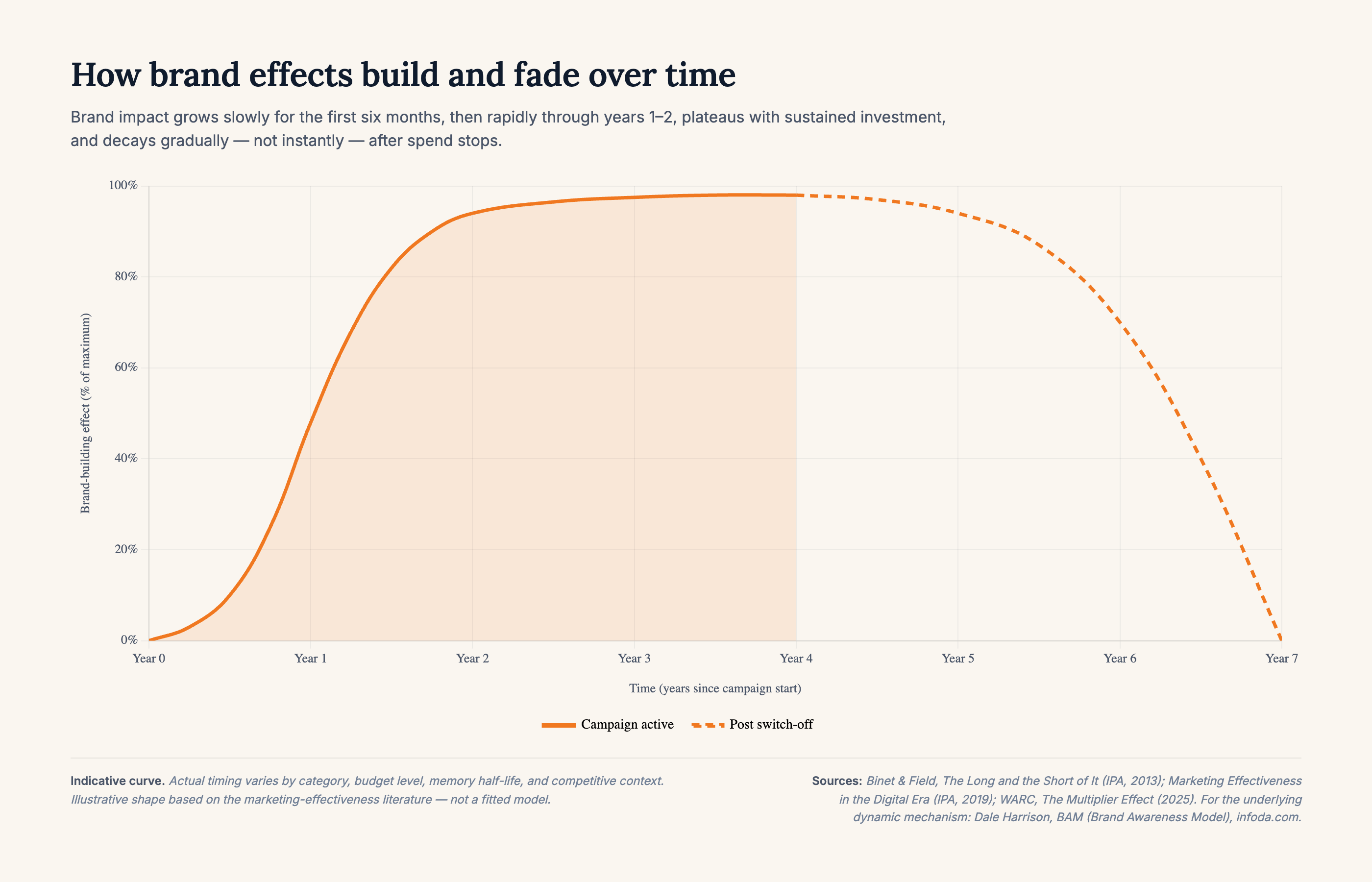
The chart makes three things visible that are otherwise easy to forget in a budget meeting. First, brand investment takes months to become measurable — the pressure to cut it in month three is a pressure to cut it precisely when it is about to start working. Second, the plateau is not free; it is the reward for sustained investment. And third, the decay after switch-off is slow enough that a business can convince itself the brand is fine for a year or more, right up until the point where rotation collapses and there is no easy way back.
The Scale-Up Trap: Where 4P Alignment Meets Capital Allocation
The most expensive mistake a small brand makes is applying Scale-Up or Maturity thinking to a Start-Up problem.
Running national TV before consumer pull is proven. Expanding to fifteen retail partners before rate of sale in the first three is compelling. Launching a loyalty programme before there is a customer base worth retaining. Broadening the product range before the Hero Product has meaningful penetration.
These are not rare decisions made by obviously bad teams. They are extremely common decisions made by ambitious, well-resourced teams under investor pressure. The investor who has written a cheque wants to see a growth story. The growth story requires scale. Scale requires distribution and advertising. The brand team, keen to deliver, builds the scale before the foundation is ready.
The result is predictable: stock unsold in new distribution, listings lost when rate of sale disappoints, promotional spend deployed to clear inventory that then establishes a discounted reference price, capital burned, and a brand that has proven it can generate volume under promotional conditions but has not proven it can generate pull at full price. The damage is often irreparable in the original channel.
During my time as CMO, I aimed always to improve the business. Historically, product, marketing, and sales sat in separate functions with separate priorities — a common structure and a common problem. In the first part of 2023 I started to change that. Product, marketing, and sales were brought closer together, and at the beginning of 2024 the management board decided to now be operated at category level, in the same teams, on the same P&L. Every 4P decision — what SKUs to invest in, how to price, where to distribute, how to communicate — got made by the people who owned all four levers together.
The preparation of the category-management setup in 2023 let me build a coherent relaunch strategy. Portfolio clarity: focus the brand on core product and category lines rather than trying to be everywhere. Distribution breadth: build presence across drugstore, food retail, e-commerce, organic specialist, and foodservice — not one channel treated as core with the others treated as afterthought. Shelf visibility: rework the on-shelf presentation so the relaunched line stood out from far away. Media doubled down on the platforms where the team had genuine expertise — the brand's X account became the most successful food brand on X in Germany, nominated for the Deutscher Preis für Onlinekommunikation. And the trade-facing side pushed rotation improvement through the new shelf treatment.
The strategy worked. Brand awareness ended the year at 29.2%, up two points. Rotation on the relaunched line increased by roughly 14%. The first converted products delivered 7.5% growth on relaunch. UVP could be raised without losing rotation, and purchase acts per household increased. All the leading indicators that a coordinated 4P push is supposed to produce, produced.
Then the operational ceiling appeared. The demand generated by the strategy outran the fulfilment capacity available to serve it. €7.0 million in orders had to be cancelled in 2024. Revenue came in at €10.8 million, down from €16.4 million the year before — a potential growth of 8.5% that could not be realised, not because the brand had weakened, but because the business had focused investment in scaling own production capacity for future growth rather than on short-term fulfilment expansion.
This is the Scale-Up phase in one of its structural forms — the phase where a well-executed 4P strategy creates real, measurable demand, and where that demand meets the capital-allocation reality of a growing business. Every brand in this phase faces the same trade-off: available capital either goes to immediate fulfilment capacity — buying finished goods, expanding co-packing, funding short-term surge — or it goes to long-term structural capacity, own production, distribution infrastructure, category ownership. Both paths are defensible. Both have visible consequences. The CMO's role in this moment is not to make that call unilaterally — the capital-allocation decision belongs to the full executive team — but to make the demand curve visible and quantified, so the trade-off is made with full information. Mental availability drives buyers to your shelf. Physical availability, in Scale-Up phase, is as much a capital-allocation question as an operational one. The CMO who has spent years driving mental-availability build is often the person best placed to name the moment when the two are diverging.
The diagnostic is simple, and it requires honesty. Two questions:
- What is the rate of sale per distribution point, at full price, without promotion?
- What is the repurchase rate among buyers who purchased at full price?
If both numbers are at or above category benchmark, consumer pull is real and Scale-Up can begin. If either number is weak, you are still in Start-Up regardless of your revenue figure, your distribution footprint, or what your investors believe.
How Frequency Can Be Changed
The general rule — that purchase frequency is set by life circumstances and cannot be moved by advertising — is correct in most situations. But frequency can be moved through three specific mechanisms. They are worth knowing precisely because they are so rarely executed well, and when they are, the compounding effect on brand volume is significant.
Health or lifestyle framing — unlocking permission
Most frequency restrictions are not about desire. They are about permission. Buyers who would like to consume more of a product do not do so because of a perceived constraint — health concerns, social norms, guilt, cost justification. The product is associated with indulgence or excess, and that association creates a ceiling on how often buyers allow themselves to purchase.
The health or lifestyle framing mechanism removes that constraint. "A glass of red wine a day is good for your heart" did not teach people to enjoy wine. They already enjoyed it. It removed the friction that limited how often they allowed themselves to have it. The desire was already there. The framing unlocked it.
The same mechanism applied to chocolate when research on flavonoids in dark chocolate received media coverage. Sales of dark chocolate increased not because consumers suddenly liked the product more, but because the health narrative gave them permission to buy more often.
For this mechanism to work, the framing must be credible — grounded in genuine research, not manufactured claims. And it must be distributed through channels that carry credibility: journalism, medical community endorsement, independent commentary. The brand that publishes its own health claims generates far less permission-unlocking than the brand whose health credentials are validated by external voices.
Pack design and usage cues — changing the default
The amount consumers use per occasion is partly determined by how the product is packaged and how usage is depicted in advertising. These defaults operate below the level of conscious decision-making. Buyers do not calculate how much to use; they follow the visual cue from the packaging opening, the serving suggestion, the image of the product being used.
Make the tube opening larger and more product comes out per use — without the consumer deciding to use more. The default serving size, the size of the spoon shown next to the powder, the image of the finished drink — all of these shape the quantity used per occasion more than any explicit instruction.
This mechanism applies across categories: FMCG products, beverages, supplements, cleaning products. The question for the brand team is: what is the implicit usage cue we are providing, and does it align with a usage rate that benefits the brand?
A well-known example: toothpaste advertising consistently shows a full ribbon of paste running the entire length of the toothbrush. There is no dental reason for this amount — much less is enough to clean teeth. But it became the visual norm, and average toothpaste usage per brushing reflected it. The norm was not imposed — it was shown.
New occasions — repositioning use context
Creating a genuinely new use occasion for an existing product is the highest-effort, highest-reward frequency mechanism. The product does not change. The situation in which it is used changes.
Listerine's journey from surgical antiseptic to daily oral hygiene product to morning breath solution is the canonical example. Each repositioning created a new occasion for the same product — and each occasion compounded on the previous one rather than replacing it. A consumer who uses Listerine after brushing in the morning and again after lunch is using it more than twice as often as a consumer who uses it only after brushing. The product is identical; the occasions multiplied.
The same mechanism operates when Red Bull positioned itself as the mixer for vodka in clubs — adding a nighttime social occasion to its existing daytime performance occasion. When Häagen-Dazs repositioned as an intimate luxury experience for couples — adding a romantic occasion to its existing personal indulgence occasion.
Creating a new occasion requires genuine insight into consumer life. It is not a brand decision made in a strategy presentation. It is discovered through close observation of when, where, and with whom consumers actually use the category — and finding the space in that landscape where a new occasion is plausible and underserved.
The principle underneath all three mechanisms: frequency strategies work by expanding the contexts in which a product is used, not by pressuring existing users to consume more of the same occasion. Pressure advertising does not move frequency. Context change does.
The Phase Framework Applied to Marketing Investment
Understanding the three phases produces a direct output for budget allocation decisions.
In Start-Up, the marketing investment priority is: product refinement and channel-specific presence in the lowest-barrier distribution channel. Not advertising. Not brand. Product-channel fit, with enough consumer-facing presence to generate honest feedback and repeat purchase data. If there is media budget, spend it on reaching buyers in the specific channel you are in — not on brand awareness at national scale.
In Scale-Up, the priority is: distribution investment and the first brand investment. The distribution investment goes into sales function, retailer relationships, and the operational infrastructure to service multiple distribution points. The brand investment begins building mental availability at the scale of the new distribution footprint. ATL investment becomes relevant when the distribution exists to convert it.
In Maturity, the priority is: sustained brand investment at full market scale, portfolio discipline, and price architecture management. The failure mode here is complacency — assuming that the brand's established position protects it from the need for continued investment. It does not. Mental availability depreciates, and competitors who invest continuously will erode it.
The CMO's job at each transition is to recognise the phase change and shift investment accordingly. The skills that made you successful in one phase will make you unsuccessful in the next if you do not update them.
The CMO's Growth Thesis
Every CMO should be able to articulate, clearly and concisely, why their brand will be larger in three years than it is today. Not "we will run better campaigns" or "we will improve our digital marketing." A specific, evidenced growth thesis grounded in the framework above.
The growth thesis has three components:
First, the penetration opportunity: who are the buyers who do not currently purchase the brand, what is the total pool of them, and what is the mechanism by which the brand will reach them? This is the "More Targets" vector, quantified.
Second, the availability investment: what distribution points are currently absent that represent accessible, prioritised opportunities, and what does the expansion path look like? This is the "More Presence" vector, sequenced.
Third, the phase awareness: is the brand in Start-Up, Scale-Up, or Maturity, and what does the data say about which phase it is in? This determines which investments are appropriate and which would be premature.
A CMO who can walk into a board meeting and articulate those three things — the buyer pool, the distribution path, and the phase — with supporting data is speaking in the language of business strategy. A CMO who presents campaign metrics without this foundation is speaking in the language of marketing activity.
The growth thesis is not a slide. It is a thinking discipline. It should inform every budget decision, every channel choice, every product launch sequence, every distribution negotiation. It is the CMO's primary strategic document — and it starts from an honest answer to a simple question: does our consumer pull data support the next phase, or do we still have work to do in this one?